Pixels releases AI-powered reward infrastructure "Stacked" to external studios—transitioning to a USDC reward model to reduce selling pressure on PIXEL.
- 2026.03.28
- News

Pixels announced the transition to the AI reward infrastructure "Stacked" and USDC payouts. How are they attempting to overcome the inherent contradiction of P2E, where distributing tokens leads to price collapse, through AI-driven reward optimization and a redesign of the economic structure? Let's analyze the structure and potential.
Pixels has introduced a report base called 'Stacked' that utilizes AI. It is a test to see the design of the game report from the basics. Recently, in AMA, it was clarified that part of the report will be supported by USDC. The token distribution will be limited — Play-to-Earn is starting to gain traction in this industry, and a movement towards a more positive direction is beginning.
The failure of the P2E model and the 'problem of being too greedy'
|
|
Source : www.geekmetaverse.com |
When distributing tokens, the cost may die.
The Play-to-Earn model of blockchain games has developed through the integration of tokenomics. However, from the outset, there has been a time-limited explosion in the market. If a large amount of tokens is released, the supply in the market increases, and the value decreases. This contradiction has been a structural issue for P2E.
Particularly from 2024 onwards, the market for game tokens has become increasingly difficult. The long-term sustainability has been lost, and once you invest, the movement to sell immediately has become prevalent. Even the developers of Pixels have stated that "retail investors are already getting tired," reflecting the overall atmosphere of the market. "If a large amount is released, the value will decrease," this situation has led to many games being submerged.
"The same report to all members" is an unreasonable connection.
The recent P2E has had another issue. Many games have adopted a design that distributes rewards in the same way to anyone. However, this uniform distribution has led to a situation where it does not generate sustainable profits, and it has accelerated the emergence of tokenomics without any regulation.
Pixels' Luke Baulch has stated that the recent reward system is 'holding all players to the same standard and promoting different actions.' Without considering who will pass through, the economy must inevitably collapse. The result of that contradiction has been the emergence of an AI-optimized approach to rewards.
AI report foundation 'Stacked' work structure
|
|
Source : www.geekmetaverse.com |
The idea of using "investment" as a means of reporting.
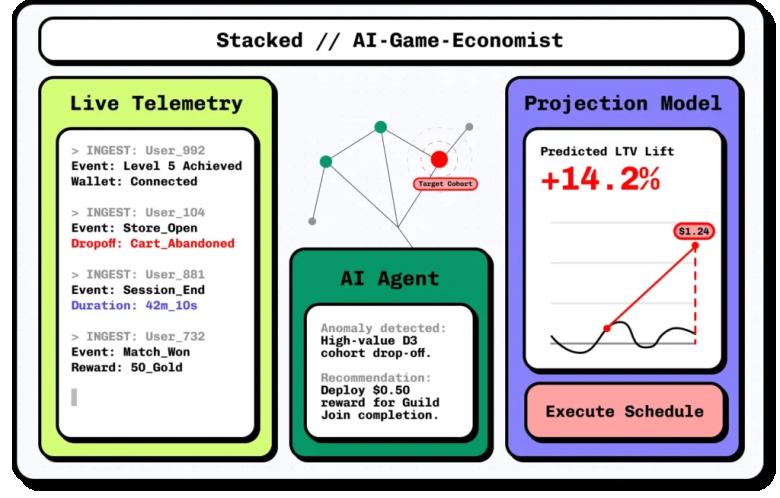
"Stacked" is an AI platform that reads and analyzes player movements in real-time, suggesting the most suitable strategies for each individual. By integrating the SDK, it collects game data and determines whether "this player is likely to disengage" or "there is potential for movement in response to the lesson." The AI makes predictions and establishes a timing that aligns with the in-game context and objectives.
What is being pointed out is not "distributed to all members," but rather a design that states, "For those who are essential, it is necessary to pass through essential moments." It is not just about casting reports as a cost, but rather focusing on areas where results can be observed, directing ROI towards the gathered insights—essentially, it is also a trial that incorporates financial theory into the game economy.
The power of numbers to speak, the strength of precision
|
|
Source : www.geekmetaverse.com |
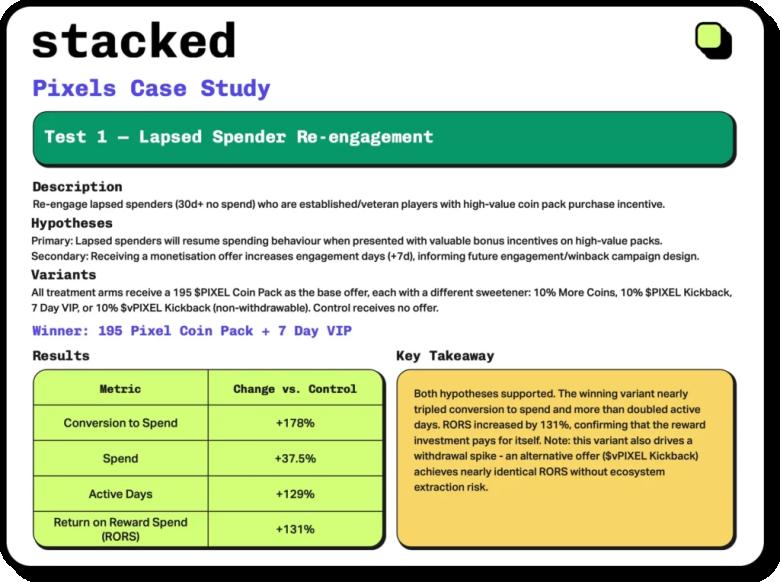
The operational data obtained by Pixels within the company reflects the effectiveness of this idea. In the strategy for re-engagement with disengaged users, the transfer rate of funds increased by 178%, and the number of active days increased by 129%. The return on investment related to advertising reached 131%.
The point to note is that it is not enough to simply increase the amount of advertising; rather, it is about raising the quality of the distribution. The results will be more pronounced. "Even if it decreases, it can still rise"—this reverse correlation suggests that Stacked is likely to show this intrinsic value.
Meaning of USDC payout movement
"Sow" and "Sell" are separated.
The USDC report supported by AMA, when viewed as a significant change in local taste, is a major transformation. In the upcoming P2E, the report was something that was tied to a nitty-gritty. As the play-to-earn becomes monetized, the need for a mandatory sale surge has definitely arisen.
If you can receive reports in USDC, the necessity for the play-to-earn to sell PIXEL will not be necessary. The separation of 'receiving reports' and 'selling tokens' will be severed. If this configuration can be enabled, the short-term sale surge will decrease, and the price of tokens will also decline. By dividing the game’s economic situation and the investment market, it will become a significant transformation in that sense. There is also a movement to redefine PIXEL from 'something to receive reports' to 'something to hold value and maintain participation rights.'
Measuring as 'investment' is not 'cost'.
Pixels are a game that focuses on "Return On Reward Spend (RORS)"—a metric that asks how much profit is generated from the distributed tokens. By optimizing with USDC and AI, this concept begins to take a concrete form.
AI captures the output of unrestricted tokens, USDC absorbs the dynamic risk, and $PIXEL is being driven towards the demand side. If these three come together, the token's infrastructure can be structurally controlled. To put it simply, continuing this as a game operation is not something that can be easily determined.
$PIXEL pricing is effective.
"Is it possible to create a 'situation where it is not sold'?"
This time's configuration change will focus on ways to provide supply pressure, even if it's not much. The important point is that it can be realized in a situation where 'there is no need to sell PIXEL to make a profit.' If USDC's monetization is completed, it will be possible to realize a situation where 'there is no need to sell PIXEL.'
If USDC's monetization is completed, the mechanism that allows PIXEL to be released will weaken. If a configuration that requires $PIXEL to be involved in staking or game participation is maintained, the necessary supply will continue to be limited.
"The risk that is not safe will become a token."
However, it's not even that simple to enjoy it with just a hand release. If the report is transferred to USDC, the existence significance of PIXEL will not be weak. The requirement for the report's objective is to be eliminated, and the investment capital should not be too much of a burden, and the cost of the upper limit of the profit will not be too much. "It was hard to break, but it was also not a top-down token" — such a change in nature is quite common.
To protect this balance, the existence significance of PIXEL will not be weak. The requirement for the report's objective is to be eliminated, and the investment capital should not be too much of a burden, and the cost of the upper limit of the profit will not be too much. "It was hard to break, but it was also not a top-down token" — such a change in nature is quite common. To protect this balance, it is important to continue to design a strong use case that utilizes PIXEL to the fullest.
Conclusion: The cost standard is determined by the first hand that is placed in the design sequence.
The optimization of reporting by AI and the combination of USDC payouts is a force that can prevent the failure of the upcoming 'collapse in inflation.' However, that does not mean it is 'automatically secure.' It is necessary to first establish a discussion based on the requirements side's design. The test of Pixels suggests that P2E should 'evolve from a playful model' to 'a model that continues to be sustainable,' and it is likely to be a genuine model that can be avoided from being overwhelmed.
Matome
The upcoming P2E has been designed to bring about self-destruction as much as possible. Pixels aims to enhance the quality of reports through AI and facilitate the movement towards USDC, while simultaneously trying to eliminate the two diseases of excessive supply and distribution. The question being asked is not 'What can be distributed?' but rather 'Who, when, and why can it be distributed?' The gaming economy is increasingly entering the realm of financial engineering. The evaluation criteria from here will not only depend on how the tokens are rising but also on how long that economy continues to thrive.
PIXELS
Game Summary
"PIXELS" is a blockchain-based platform where players can create virtual art using individual pixels and trade these as NFTs in the marketplace. The game encourages collaboration within the community and features systems such as energy management and guilds, which foster both cooperative and competitive play.
Game Content
In "PIXELS," players use a pixel-based mechanic to create and customize artwork. Players can explore different quests, acquire skills, and engage with other community members. The game world includes a city called Terra Villa that players can explore.
Features
Art Creation: Players create art using pixels and can mint these artworks as NFTs.
Marketplace: Artworks can be traded and sold within an integrated marketplace.
Quests and Skills: Players can complete various in-game quests and unlock new skills.
Guilds and Social Structures: Players can form or join guilds to collaborate or compete with each other.
Energy System: Energy is required for activities, which can be replenished through various game mechanics.
Land System: Players can own and customize land within the game, adding another layer of strategy.
◾️Basic Information
Game Title: PIXELS
Genre: Art Creation & NFT Marketplace
Compatibility: Web Browser
Price: Free to play with in-game purchases
Development Status: Active
P2E: Yes
Blockchain: Ronin
Tokens: NFTs (created art pieces)
NFT: Yes
Provider/Developer: Banger Inc.