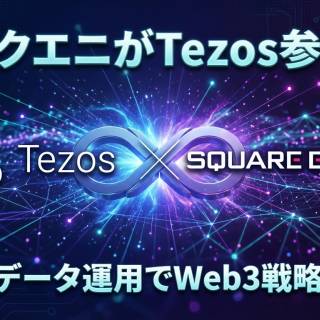
Square Enix appointed as a validator (baker) for the Tezos blockchain — a major gaming company's full-scale participation in the chain.
- 2026.03.19
- News
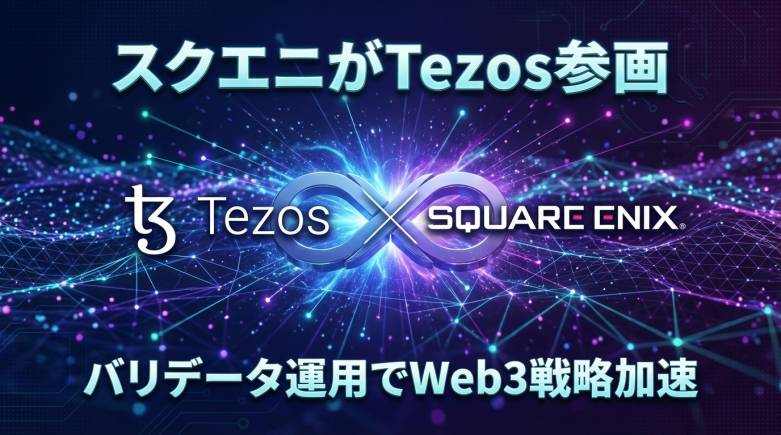
Square Enix has announced its candidacy as a Tezos validator (baker). We delve into the background of their decision to operate a node, the ripple effects in the blockchain gaming sector, and the growth vision of the Tezos ecosystem.
Sukuwēa Enikusu (Head office: Shinbashi, Minato City, Tokyo) has started operating on the blockchain 'Tezos' as a bridge (by Pykā) and announced it. The movement of the company to incorporate its own infrastructure is likely to blow a new wind into the world of Web3 games.
Sukeni is participating in the Tezos blockchain.
The project 'Squid Ink' has started the operation of 'Picard' on the Tezos blockchain. The 'Picard' is a tool for verifying references and generating blockchains, supporting the network's infrastructure.
Up until now, the Squid Ink has been positioned as an investment for investors. However, this time, with the current hand, it will shift from the 'using side' to the 'moving side'. By utilizing the network itself, it will deepen the understanding of technology, and directly contribute to the maintenance of network infrastructure.
The company's CEO, Yoshinori Takeda, has also been involved in the investment strategy related to the number of blocks up until now, and this time, he is clearly aiming to align technology with the current operations.
From the investment to participation in the inflow, that one step is meaningful.
Skwea and Enix have reached this point, having invested in projects like 'The Sandbox' and 'HyperPlay', connecting to the world of Web3.
This time's Tezos participation is a story that has already begun to unfold. Not only by putting out money, but also by moving to a place where we can support the foundation of blockchain ourselves. To become a breeder means to take on responsibilities for the staking and network security.
The example of a gaming company diving into the infrastructure is still rare. Therefore, the industry's eyes are focused on this movement.
Tezos is increasing its presence in the gaming world.
Tezos is a proof-of-stake blockchain that uses a self-amending protocol, allowing for on-chain governance. It features a design that can support smart contracts and has been recognized for its strong performance in relation to its ecosystem.
The ecosystem is expected to reach 4 million unique users by 2025, with an increase of 3.1 million transactions per month, indicating that it is growing steadily.
From the mobile game to large-scale multi-player environments, the wide range of titles has begun to accumulate, and it is firmly establishing itself as a strong contender in the gaming space.
The atmosphere changes when a master joins.
The Tezos development organization Trilitech welcomes participation in the 'increasing trust in the gaming industry' initiative.
The well-known expert in the field, Patrick, adds that the addition of the network's trust is not something that can be taken lightly. Developers and other companies should be encouraged to 'consider jumping on board.'
Tezos has been known to maintain a strong presence in the gaming industry and sports organizations. It is also working to expand the pathways for Web3 gaming.
Brookchain game has entered the next stage.
This time's movement is showing the stage where game companies are going beyond the 'use' of NFTs and tokens, starting from the roots of blockchain.
Regarding Web3 games, discussions about ownership rights of in-game assets and market price regulations have become quite common. However, if you participate as a player, it will lead to a situation where the net worth of those assets will fluctuate. The scope of the discussion is different.
The major players in the industry are increasingly adding to their influence through infrastructure operations, and the integration of games and blockchain is likely to become deeper than ever before.
The role of the game company is expanding.
The gaming industry from here is not just about 'creating something that looks good,' but also about 'developing a network in one go' as a role to take on.
The knowledge gained from utilizing the bridge for the operation of the barrier is also likely to lead to new game design ideas.
The strategy of our team regarding the direction of influencers and content creators will become stronger as we strive to win in the Web3 era.
Matome
The Tezos blockchain for the Skuya & Enix project shows a flow that indicates the relationship between the gaming industry and the application layer, providing a representative glimpse into this aspect.
As the era of using NFTs approaches, the discrepancies are becoming less pronounced, and comprehensive discussions regarding the design of net work operations and token economics are likely to arise.
How major players move and influence other companies is something to watch for in the future.